The Collections Health Check: Is Your Recovery Process Working as Smart as It Could?
From EMI bounces and SMA buckets to field agencies, regional-language conversations and repayment reconciliation. Find out where your collections processes can work smarter.

Beyond the Dashboard
Every NBFC has a collections process. EMI reminders go out, bounced payments are flagged, collection executives make calls, field agencies follow up, and recovery numbers are reviewed at the end of the month.
On paper, the system works.
But what happens between these activities often tells a different story.
A borrower who has already promised to pay receives another automated reminder. A field executive visits an address without knowing that the customer spoke to the call centre that morning. Someone makes a UPI payment, but the collections team continues following up because the transaction has not yet been reconciled.
Individually, these may seem like minor operational issues. Across thousands of loan accounts, they can create unnecessary costs, slower recoveries, frustrated borrowers and avoidable portfolio deterioration.
This raises an important question for lenders: How healthy is your collections operation beyond the numbers reported on your dashboard?
The answer requires looking more closely at how the entire collections journey works.
1. An EMI Bounce Should Trigger Understanding, Not Just Another Reminder
Consider a customer whose EMI is due on the fifth of every month. The payment fails, and the account automatically enters the collections workflow.
A reminder is sent. Another follows. Eventually, an agent calls.
But what if the customer's salary now arrives on the seventh? What if the bank mandate failed despite sufficient funds? What if the borrower runs a small business and receives most payments after the tenth?
The collections process may be functioning exactly as designed while failing to address the actual reason behind the missed payment.
This distinction matters enormously in India, where borrowers include salaried employees, gig workers, shopkeepers, small business owners and individuals with irregular income cycles.
A healthier collections process distinguishes between temporary payment friction, genuine financial stress and borrowers who repeatedly fail to honour repayment commitments.
It uses available repayment history, bounce reasons, previous conversations and account behaviour to decide what should happen next.
Sometimes the right intervention is a simple payment link. Sometimes it is a conversation about repayment timing. In other cases, the account may need closer monitoring or human intervention.
The health check question: Does your collections system understand why an EMI failed, or does every failed payment trigger essentially the same sequence?
2. Are You Intervening Early Enough to Prevent SMA Roll-Forwards?
In collections, timing is often as important as the action itself.
Under the RBI's applicable asset-classification framework, overdue loan accounts can move through SMA-0, SMA-1 and SMA-2 as delinquency deepens, with the standard thresholds progressing through 30, 60 and 90 days overdue.
For a collections leader, these classifications represent more than regulatory reporting categories. They indicate how quickly an account may be moving away from regular repayment behaviour.
A borrower who misses an EMI for the first time should not necessarily receive the same treatment as someone who has repeatedly broken payment commitments.
Yet many collections operations remain heavily focused on accounts already showing significant delinquency, rather than identifying and addressing risk earlier.
By the time an account reaches a later bucket, the lender may have spent considerable effort on reminders, calls, agency allocation and field visits. The chances of securing repayment can also change as delinquency persists.
An intelligent collections operation looks for warning signs before further deterioration. Repeated mandate failures, declining responsiveness, partial payments and broken promises to pay can all contribute to a more complete assessment of repayment risk.
The goal is not to intensify collections activity at the earliest possible stage. It is to identify the right intervention before a manageable repayment issue becomes a more expensive recovery problem.
The health check question: Can your team identify accounts at risk of moving into the next delinquency bucket, or does it react primarily after the roll-forward has occurred?
3. Your Field Agencies May Be Working Hard. But Are They Working With the Right Information?
Field collections remain an important part of India's lending ecosystem, particularly where digital communication alone is insufficient.
However, deploying people on the ground does not automatically translate into an efficient collections operation.
Imagine an agency executive travelling across a district to contact five borrowers. Two have already made payments. Another has agreed to pay the next day. One requires a follow-up in a different location, and only one genuinely needs a visit.
The executive may have completed the assigned route, but much of that effort could have been avoided with more current information.
This is where coordination between lenders, central collections teams and external agencies becomes essential.
Field allocation should ideally account for previous contact attempts, payment status, borrower availability, account priority and the likelihood that an in-person visit will add value.
Just as importantly, information gathered during field visits should flow back into the central collections system. If an agent learns that a borrower has relocated, is facing temporary financial difficulty or has disputed an outstanding amount, that information should shape subsequent actions.
Otherwise, the organisation repeatedly pays to rediscover information it already possesses.
The health check question: Do your field agencies operate with an up-to-date view of each account, and can your central team see what actually happened during every visit?
4. In India, the Language of a Collections Conversation Matters
A borrower in Nashik, a shopkeeper in Jaipur and a small business owner in Kolkata may all have similar repayment obligations. That does not mean they should receive identical communication.
Collections conversations involve financial information, personal circumstances and, sometimes, difficult decisions.
The language used can influence how clearly the borrower understands the outstanding amount, available repayment channels and next steps.
For millions of Indians, a conversation in Hindi, Marathi, Bengali, Tamil, Telugu or another familiar language may be more useful than a standardised English message.
But effective regional-language communication involves more than translating a script.
The tone must be respectful. The repayment instructions must be easy to follow. The conversation must leave room for the borrower to explain their circumstances rather than simply respond to a demand.
Technology can help make multilingual communication more scalable through appropriately designed voice systems, messaging journeys and agent-assistance tools. However, automation should also recognise when a situation requires a trained human representative.
The objective is not to make every collections conversation longer. It is to make the conversation more productive.
The health check question: Are your communication journeys designed around borrowers' language preferences and circumstances, or primarily around the operational convenience of your collections team?
5. A Payment Received Is Not the Same as a Payment Reconciled
Few things damage borrower confidence faster than receiving a collections call after making a payment.
For lenders operating across UPI, bank transfers, automated mandates, payment links and authorised field collection channels, reconciliation is a critical part of the recovery journey.
Consider a borrower who makes a payment in the morning through a digital link. The transaction is successful, but the updated status does not immediately reach the collections platform.
An automated reminder is sent in the afternoon. An agent calls that evening. The borrower explains that payment has already been made and is asked to share proof.
The collection has technically succeeded, yet the experience has deteriorated.
At scale, reconciliation gaps can also affect reporting accuracy, agency performance measurement and resource allocation.
A healthier workflow ensures that payment confirmations, loan-account posting, collection status updates and the suppression of unnecessary follow-ups are closely coordinated.
This is particularly important where multiple technology systems, payment partners and collection agencies are involved.
For digital lending, the RBI's 2025 directions also establish specific requirements around repayment flows and the handling of cash recovery, making accurate payment accounting an operational and compliance priority.
The health check question: How quickly does a successful borrower payment become visible across every system and team responsible for that account?
6. Are You Measuring Collections Activity or Collections Effectiveness?
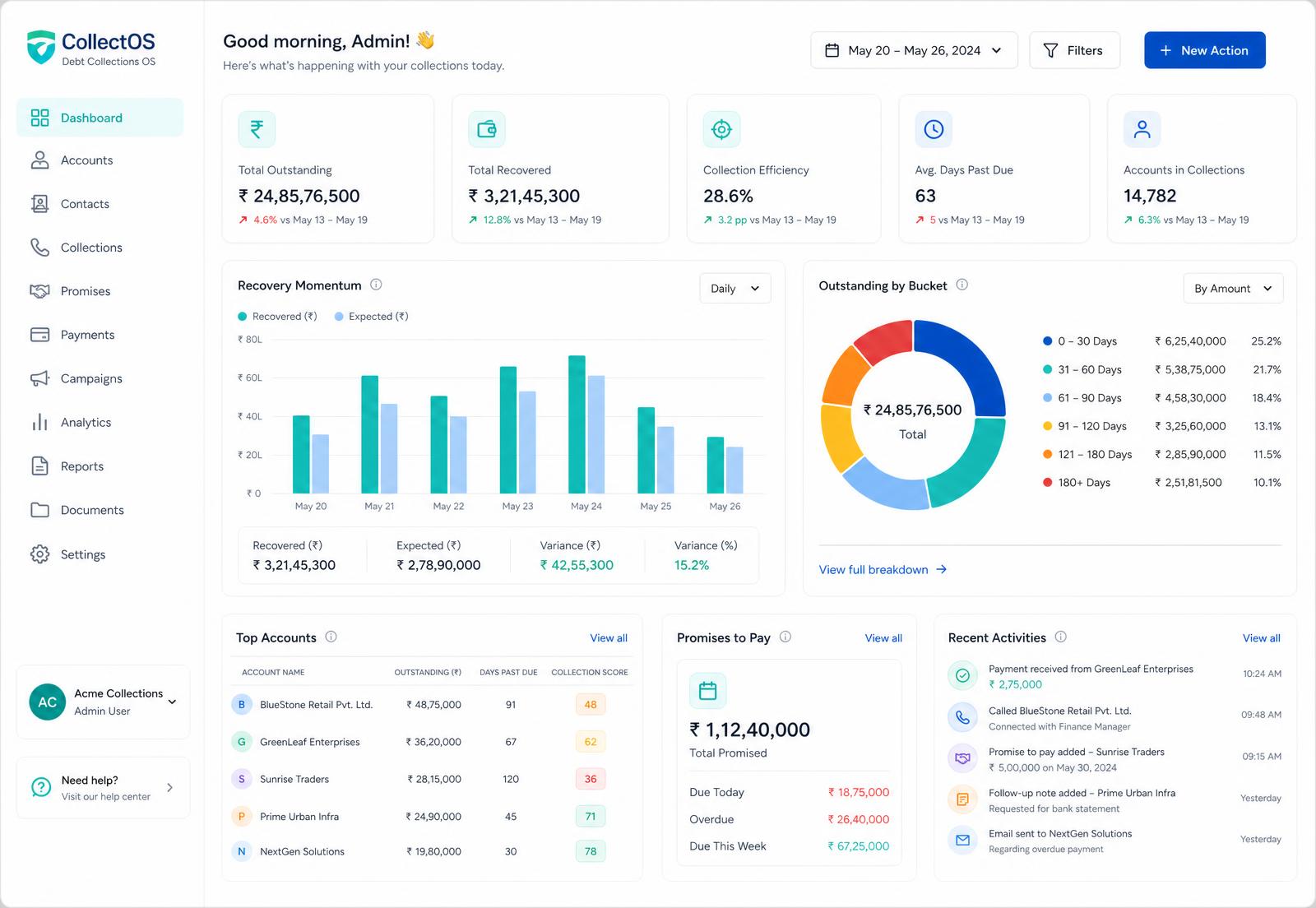
Collections dashboards can contain an impressive amount of data.
Calls attempted. Messages delivered. Accounts assigned. Field visits completed. Amounts recovered.
These numbers are useful, but they do not always explain whether the collections operation is becoming more effective.
A team could increase daily calling volumes without meaningfully improving recoveries. An agency could report high visit completion while contributing relatively little to actual collections. A reminder campaign could show excellent delivery rates but poor repayment conversion.
A more meaningful evaluation looks at the relationship between effort, outcomes and borrower experience.
For example, right-party contact rates reveal whether outreach is actually reaching the intended borrowers. Promise-to-pay kept rates help evaluate whether conversations result in fulfilled commitments. Cure rates and roll rates show how accounts move through delinquency stages, while cost per rupee recovered helps establish the economics of different collection strategies.
These measures become even more valuable when examined by loan product, delinquency bucket, region, agency and communication channel.
A strategy that works well for early-stage personal loans in a metropolitan market may not perform equally well for small business loans in Tier 3 cities.
The health check question: Can your dashboard tell you which collection activities are genuinely improving recoveries, or does it primarily tell you how busy your operation has been?
7. Is Compliance Built Into the Workflow?
For Indian lenders, collection effectiveness cannot be separated from borrower protection and regulatory compliance.
The RBI's responsible business conduct framework places clear responsibilities on NBFCs regarding fair practices, recovery agent conduct, customer confidentiality and grievance handling.
These expectations matter whether collections are managed internally or outsourced.
However, compliance becomes harder to maintain when borrower interactions are spread across disconnected systems, agencies and communication channels.
An organisation needs more than written policies. It needs operational controls that help teams follow those policies consistently.
This includes maintaining reliable contact histories, applying appropriate communication restrictions, monitoring agency conduct, recording complaints and ensuring that borrowers have access to suitable escalation mechanisms.
It also means recognising the differences between applicable regulatory requirements for various lending products, including microfinance.
Technology cannot replace accountability. It can, however, make the collections process more transparent, traceable and easier to supervise.
The health check question: Can your organisation demonstrate what happened during a collections interaction, who was responsible and whether the required procedures were followed?
The Real Opportunity Is in Connecting the Entire Collections Journey
Most lenders do not struggle because they lack a collections process.
They struggle because individual parts of that process do not always work together.
The loan management system identifies an overdue account. The communications platform sends reminders. The call centre records conversations. A field agency maintains its own updates. The payment system confirms transactions. Management reviews the numbers.
Each function may be doing its job, but important information can get lost between them.
This is where collections technology has the potential to create meaningful value.
A connected collections operation can use data to determine which accounts need attention, coordinate communication across channels, assist collection agents, monitor repayment commitments and provide a consolidated view of outcomes.
More importantly, it can reduce avoidable activity while making room for better borrower conversations.
For an NBFC looking to scale its portfolio without proportionately increasing collection costs, this is not simply a technology upgrade. It is an opportunity to improve how the entire recovery function operates.
How Healthy Is Your Collections Operation?
Before adding more agents, launching another reminder campaign or investing in a new system, it is worth asking whether the existing collections journey is performing as well as it should.
Are you intervening at the right time? Are your field teams receiving useful information? Can borrowers communicate comfortably? Are payments reflected promptly? Can you identify the operational activities that genuinely contribute to recovery?
These questions can reveal gaps that conventional collections dashboards may overlook.
And identifying those gaps is the first step towards improving both operational performance and borrower experience.
Take the FrenzoFinserv Collections Health Check
Discover where your collections processes may be creating unnecessary friction and where smarter workflows, better intelligence and more connected conversations could make a difference.
Because better collections are not necessarily about making more calls, sending more reminders or increasing pressure.
They are about making every intervention more relevant, every conversation more meaningful and every recovery effort more effective.
FrenzoFinserv. Calm Conversations. Stronger Collections.
See How FrenzoFinserv Puts This into Practice
Our platform turns these ideas into daily operations for NBFCs, fintechs, and digital lenders across India.
Book a demo